As far back as 1966, back when American River College had been paved into existence nearly a decade before, the Sacramento Metro bus system used the ARC parking lot as a bus station, making the college accessible to Sacramento residents anywhere the bus lines reached. Nowadays, with more colleges added to the Los Rios district and the light rail system, ARC is serviced by only two bus lines.
ARC Math Professor Benjamin Etgen would like to change that.
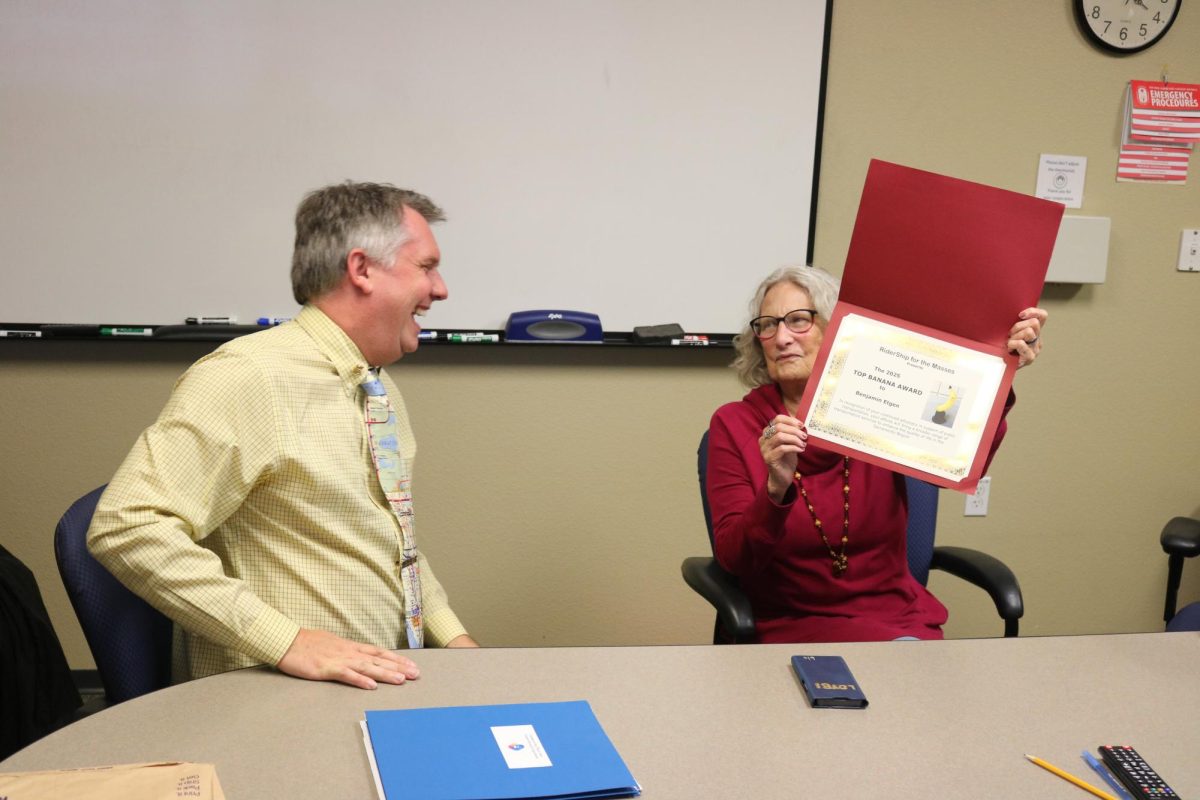
On Nov. 13, Etgen was the recipient of the “Top Banana” award from “Ridership for the Masses,” a local transit advocacy organization that specifically advocates for the transportation access of low-income riders, students, seniors, disabled persons and anyone with accessibility limitations that would be reliant upon public transportation. This award is reserved for any “individual who has made a difference for public transit riders or an organization that positively changes public transit in the Sacramento Region,” the organization’s website states.
Etgen is receiving this award fresh off of the heels of his recent report titled “Lessons of the Thirty Year Transit Experiment.” In the report, Etgen goes into granular detail about how to better utilize the Sacramento mass transit system to provide more communities with bus routes so students can access higher education at ARC without being limited by car ownership.
“We’re in an interesting situation at American River College because we are easily the largest destination that has the worst service.” Etgen said. “We were about 20% of all bus trips in regional transit’s network with only two routes, ‘The One’ and ‘The 82’. So, there’s kind of a mismatch between the capacity, how capacity is allocated and where riders are.”
The report seeks to increase the volume of ARC student bus riders on the transit network by eliminating near misses to major destinations, minimizing the number of transfers a rider would need to get to major destinations, ensuring safe transfer locations and through the use of a “frequency grid,” or the strategic reorganization of bus routes to increase the scheduled frequency of bus traffic. Using the existing fleet, the report recommends changing bus routes in a manner that offers more coverage on bus routes, such as having a bus route that takes a different path in one direction as compared to the other.
“For example, if there were two routes between Sunrise Mall, American River College and the light rail station, those could be timed so that if you want to get from one major destination to another from the bus exchange at Sunrise Mall or from light rail, that can be 15 minutely, and then each of the branches half hourly.” Etgen said. “That’s called frequency doubling, and that’s something that [Regional Transit] used to do a lot.”
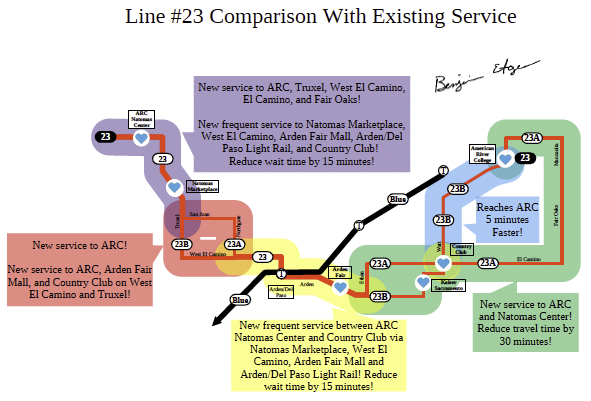
One example of the change of the bus routes recommended in the report proposes a change of line #23 to American River College. The new route would offer service between ARC main and Natomas campus, while stopping at major commercial destinations as well, all while using the existing transit resources available within the local transit network.
“Combining the #23 with the existing route serving Arden Fair, would allow students and employees to reach ARC significantly faster than today and without changing buses. This improves access to American River College for students and employees on Arden Way, El Camino, Watt Avenue and Fair Oaks Boulevard. Quicker trips would save an hour on each round-trip on Arden Way, Ethan Way, ElCamino and Fair Oaks Boulevard.” the report reads.
As a staple of the mass transit community and a constant advocate, Etgen himself began his education at ARC, using the mass transit system to shuttle him from class to home and back. This transportation routine inspired him to be a consistent advocate for mass transit, through his work with various organizations promoting a robust mass transit network throughout the Greater Sacramento region, and beyond. Barbara Stanton, who founded the pro-transit organization Ridership for the Masses, explains that Etgen’s award isn’t for any specific report, but rather the culmination of a career’s worth of transit advocacy work.
“It has nothing to do with the report. It has everything to do with the fact that he’s a longtime transit advocate,” Stanton said. “He belongs to the Train Riders Association, which actually expands his advocacy outside of the Sacramento region, for example.”
The inspiration behind his passion for transit advocacy stems from his use of the transit system as a young student at ARC, where he pursued his education. Now as an ARC educator, he finds himself back on campus, preparing reports that would bring the buses back. His personal experience grants him a keen perspective on the experience of a young Sacramento resident trying to decide whether higher education is available to them.
“That’s the upward mobility aspect [of mass transit], that you can really say to yourself ‘I’m willing to do some trade-offs in my life [to get an education],’” Etgen said. “And I’m thinking that’s when I decided I could go to college, because I realized I could make those trade-offs.
Follow William Forseth on Instagram @WilliamForseth or email him at [email protected]